

Ya gotta love a good snarky atheist meme. But this one does make you think, doesn’t it? I mean if somebody claims fairies are real, is it my job (as a fairy-skeptic) to disprove them? No! It’s their job to provide evidence for their claim. So, wouldn’t it follow that a Christian skeptic should have to give reasons for their skepticism? Are believers the only ones making claims that need to be defended? Keep reading to find out!
Memes like this are rampant. And when your kids aren’t trained to think through them well, encountering arguments like these could sow unnecessary doubts into their minds and hearts. So what is a mama bear to do? We inoculate our kiddos by exposing them early and training them through it! This blog can help. First, we’ll define some terms and discern the message of this meme. Then we’ll talk about the apologetics arguments for the existence of God, or what is called “classical apologetics.”
Defining terms: Let’s get on the same page!
There can be nuance to these terms, but for the purpose of this particular article, these definitions should clarify what we mean when we use them.
God: A powerful, immaterial, personal, Being (one with a mind and the freedom to make choices) who created the universe and everything in it. (The word “god” can have various definitions, but for the purpose of this article, this is the definition we will use).
Theist: A person who believes in a Creator God (or gods) who interacts with the world (as opposed to deists, who believe in a god who created the world and left it to run on its own without any more interaction with it.) All Christians are theists, but not all theists are Christians.
Atheist: Classically, an atheist was a person who denied God’s existence. In recent history, however, the term atheism has been broadened to mean anyone who is “unconvinced” that any God or gods exist. (i.e. “A person who lacks God belief.) The difference is that the former is making an active claim (God doesn’t exist), while the latter (with this broadened definition) makes no real claim.
Agnostic: A person who believes it cannot be known whether or not a God exists. Today, many atheists consider themselves “agnostic atheists.”
Naturalism: The belief that everything in existence is the effect of natural causes. (Completely excludes the possibility of a spiritual reality or supernatural realm)
Evidence: An object, a fact, data, or a line of reasoning which supports an argument or claim. Evidence may be submitted but needs to be evaluated for its validity.
Proof: Evidence that supports an argument with a high degree of certainty, meaning the evidence is so strong that it would be unreasonable to doubt it. Keep in mind that it can be nearly impossible to prove something with 100% certainty outside of mathematics and logic, since everything else requires some assumptions about reality. Can you prove beyond ALL doubt that we aren’t living in a matrix? (Don’t know what I’m talking about? Get yo’self some popcorn. You’ve got a movie to watch.)
Burden of Proof: The responsibility to provide evidence that backs up a claim. Typically, the one who makes the claim bears the burden of proof. For example, if Hillary and Amy were in a conversation, and Hillary claimed to have seen a pink unicorn in the woods, it would not be up to Amy to prove Hillary wrong. Amy is under no obligation to believe Hillary until Hillary provides some good evidence. (And thanks to AI, a picture is probably not going to be good enough.)

Breaking down the meme: Do Christians always have the “burden of proof”?
According to many atheists that I have interacted with, they simply “lack belief” that God exists. They argue that the theist must provide evidence of God’s existence, and that they are under no obligation to support their own worldview since they are not making any claims.
To illustrate this, here is a fictitious conversation based on real conversations I have had:
Atheist: “There is no evidence that God exists.”
Theist: “Then where did we all come from? What is the purpose of life and why is there something rather than nothing?”
Atheist: “I don’t know and I don’t claim to know. But you’re the one who claims God exists. Therefore, it is up to you to prove it to me.”
There is a bit of a bait-and-switch going on here. If the atheist had said, “I am personally unconvinced that God exists,” then they are under no obligation to support that view. However, when the atheist says something like…
“There is no evidence that God exists.” or
“A theist’s belief is just blind faith.” or
“It is unreasonable to believe in God.”
… they are baiting the theist with a claim, and then switching the burden of proof over to the theist. What they might not realize is that they are actually making claims that need support.
Here’s what we need to help our kiddos understand: Atheism is not the neutral position many atheists think it is.
Atheists see their “lack of belief” in God as a sort of objective perspective. (See image below.) We all accept the physical reality around us, but atheists would say any supernatural or spiritual belief is adding something unknown and unproven to the parts of reality we all agree on. Therefore, these additional (spiritual) beliefs need to be proven by the one who claims they are true.
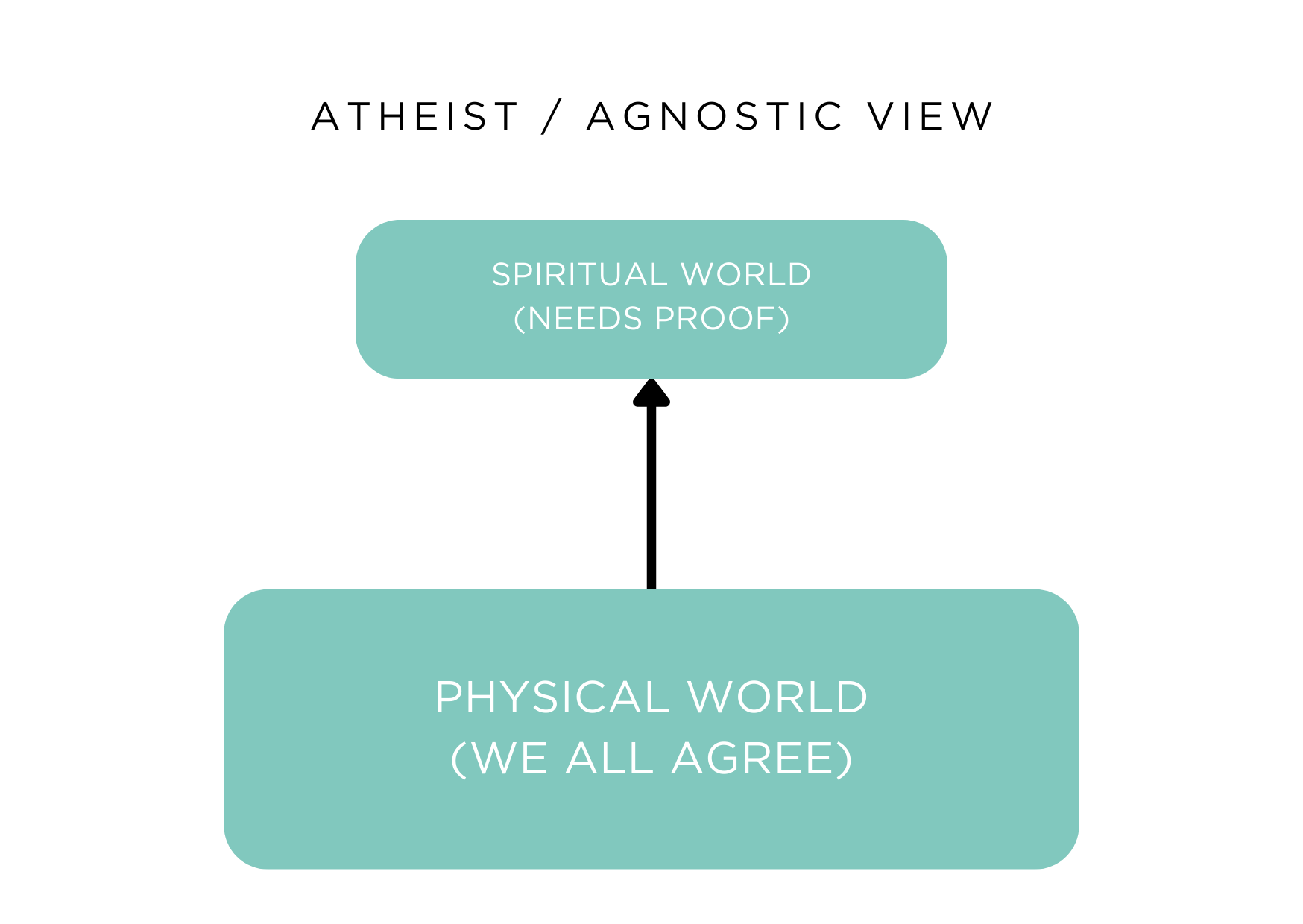
The problem is that a “lack of belief” isn’t a perspective at all. In an honest discussion, both parties should explain their basic assumptions and beliefs. This gives grounding for the conversation. But if the atheist claims, “I have no beliefs, I only accept facts,” she is kidding herself. Everyone has beliefs. Everyone makes assumptions about reality that cannot be proven. (Can you prove yesterday actually happened? Can you prove all of reality didn’t just pop into existence this morning with pre-programmed memories intact? No, but you probably assume that it didn’t.)
Rather than setting up a discussion, this creates a game where the theist loses every time. Any evidence the theist provides can be dismissed by the atheist, because she hasn’t explained how she filters the evidence. What constitute “evidence”? (i.e. you can’t provide material evidence for an immaterial phenomenon!) What would be enough to convince her? What are her assumptions and beliefs that lead her to dismiss the theist’s arguments?
Contrast that with an honest atheist who is willing to describe how she views reality. Maybe she admits to a few of her rules:
- I see order in the laws of physics.
- I accept my perception of this physical world as correct.
- I believe there are moral truths that people ought to live by.
- I trust that natural processes alone are sufficient to create the above (i.e. physics, perception, and morality).
Now we can have a productive conversation! One party claims that God explains reality, and the other party claims that natural processes are the better explaination. Both parties need to provide evidence for their view. Discuss!
Mama bears, it is important to help our kiddos recognize when they are being put in an unreasonable position. We don’t want these dishonest debate tactics to manipulate our kids into thinking that there aren’t good reasons to believe in God. And MAN are there good reasons to believe in God! This is where Classical Apologetics comes in.
Classical apologetics: Making a case for God’s existence.
What is classical apologetics?
As a reminder, the word “apologetics” comes from a Greek word that basically means to give a defense. If you meet me, I might give you an apologetic, or defense, for why DC Talk was the greatest band to ever exist. In Christian apologetics, there are a variety of methods and topics for which a Christian might argue for. Classical Apologetics specifically refers to a method of argumentation that begins with basic assumptions about reality that most people share, no matter their religious or nonreligious background. We start there, and then present arguments to demonstrate that the Christian God’s existence is the most reasonable explanation for our shared reality.
Classical apologetics involves both making arguments for God’s existence, while also refuting arguments against God’s existence. The case for God’s existence is made cumulatively. This means that there isn’t one slam-dunk argument (like video evidence of your 3-year-old stealing the cookies from the cookie jar)! Rather, there are many lines of arguments which–when considered together–make a very strong case. Like, the cookie jar is empty, your child’s step stool has been moved out of place, a bit of chocolate has been smeared low on the wall, and Little Man is suspiciously too full for his dinner. None of those alone are incriminating. (But together… come on… admit it, buddy. We know you did it.) Likewise, we can examine several lines of evidence that, together, make a powerful cumulative case for the existence of God.
Is classical apologetics just for the nerds?
Don’t get me wrong, my nerd peeps will LOVE classical apologetics (they are my people!). But mama bears, even if it doesn’t seem like “your thing,” you and your cubs need to be prepared at least with the basics. Many people see the field of Christian apologetics as purely an evangelistic tool, but it is so much more than that. Classical apologetics are great for conversations with atheists and agnostics, but they will also lay a foundation for your kids of understanding why the God of the Bible makes the most sense of our reality. Movies, music, media, and most of the messaging your kids will encounter every day are permeated with atheistic or mystical undertones. By being armed with classical apologetics arguments, your kiddos will have a better chance of spotting lies from the enemy who seeks to confuse them and derail their faith.
What if this feels overwhelming?
I have good news for you! (Besides the gospel – that’s the BEST news!) You don’t have to be a scholar or some kind of professional intellectual to be able to think through these arguments. Don’t let the enemy discourage you by making you think you’re not smart enough. And remind your kids of this!
God gave us brains and He expects us to use them (Romans 12:2). If this topic is overwhelming to you, pray and ask the Lord to give you the desire to learn, the wisdom to comprehend it, and the ability to teach it to your kids. Ask Him to reveal to you the joy and excitement of seeing how reality lines up so beautifully with the claims made in the Bible about His attributes and character. Studying Classical Apologetics really can become an act of worship! I pray you will discover a fountain of awe and joy that you may not have realized was available to us.
Truly, the best way to learn this is to teach it to your kids. And if you’re struggling to teach it, email me at alexa.rae.cramer@gmail.com. Tell me which steps I missed because we all get better together!
And if God has already wired you as a philosophy or a science nerd, let the fun begin… 🙂
What classical apologetics arguments will the Mama Bears cover (God-willing)?
- The Kalam Cosmological Argument – Did the universe come from nothing? From God? Or from the multiverse?
- The Fine-Tuning Argument – How is it that we happen to live in a just-right solar system on a just-right planet at the just-right time for advanced life to flourish?
- The Argument from Design – Down to our very cells is the appearance of engineering and design. Can this come about by natural events or do we have a creator?
- The Moral Argument – Are there such things as moral facts? Can there be a moral law without a moral lawgiver?
- The Argument from Reason – Can rational beings exist without an ultimate rational source?

Alexa is a homeschool mom of two. She became obsessed with apologetics after a season of doubt that nearly stole her faith. Alexa has a background in film and video and will willingly fight anyone who doesn’t agree that Jesus Freak is the best Christian song that ever graced the earth.


C.S. Lewis’s “God in the Dock” does not specifically address the Holocaust (often referred to as the Shoah) or the guilt associated with it in the context of Xtianity. This omission can be seen as a significant gap, especially given the profound moral and theological implications of the Holocaust for both Jewish and Xtian communities. “By their fruits you shall know them” forever condemns Xtianity as a dead religion.
Philosophical and theological arguments for the existence of God, the nature of faith, and moral reasoning which ignore “By their fruits your shall know them” exposes Xtian religious propaganda rhetoric. “Nature of faith” which ignores צדק צדק תרדוף likewise exposes empty Xtian religious rhetoric propaganda. “Moral reasoning” pales in the “Final Solution”/White Paper\Allied refusal to bomb the rail-lines which transported Jews to death camps. Lewis’s contributions to Xtian apologetics, compares to tits on a boar hog.
The historical context of the Shoah, by itself alone, challenges the credibility of Xtian teachings such as Luther’s council to gather Jews into their synagogues and burn the buildings upon them. Or the pre-Reformation decision to impose ghetto gulags upon all Jews living in Western Europe. The biblical phrase “צדק צדק תרדוף” (Justice, justice shall you pursue), underscores the expectation that faith should manifest in actions that promote justice and protect the vulnerable. The failure to uphold these principles in the face of systemic evil raises critical questions about the authenticity of faith.
Hello! Have you heard of the new debate technique used successfully by atheists/agnostics against the arguments of evangelical Christian apologists? Check it out:
https://lutherwasnotbornagaincom.wordpress.com/2025/12/10/the-ghost-buster-apologetic-technique-another-evangelical-apologist-bites-the-dust/
Have a nice day,
Gary
What is the basis for your definition of the Greek word απολογεια?
My understanding – based on context of 1Pet3.15 – is the word simply means an “answer”.
I have no neat formal “defense” of my faith – I am required, in a spirit of respect and gentleness (sentiments often lacking in style style “apologists” including on this site) – to provide an answer for my faith…NONE of which has anything to do with all the nifty and primarily defective “arguments” neatly trotted out for the last 2,000 years.
As usual, Jesus is totally contrary to the standard religious κοσμος into which we have all been immersed and indoctrinated.